Trailer wheel bearings help the hub turn on the axle spindle while carrying its load. They are easy to overlook because most of the working parts are hidden. Looking at the tire is not the same as checking what is happening inside the hub.
Whether you haul livestock around the Black Hills or pull an enclosed trailer for work, start with two questions: What hub system do you have, and what does its manufacturer require? A grease fitting does not answer both questions.
This guide helps you recognize service concerns, compare maintenance methods and prepare for a conversation with a shop. It is not a replacement for your trailer and axle service manuals. Bearing adjustment, lifting procedures, replacement parts and wheel-fastener torque must match your equipment.
Images in this guide are for illustration purposes only.
Signs your trailer wheel bearings need service
Take an unusual wheel-end condition seriously. Possible warning signs include abnormal heat, grinding or other new noise, lubricant leakage, excessive movement and rough rotation during a proper inspection.
These observations do not identify the failed part by themselves. A brake or another wheel-end component may be involved. Do not assume a hot hub only needs more grease, or that a quiet wheel proves the bearings are healthy.
If you notice a concern while towing, stop somewhere safe and arrange advice or assistance before continuing. Do not touch a hot hub to judge its temperature or crawl under a trailer at the roadside. There is no reliable number of miles you can safely drive on a noisy bearing.
Give the service provider a useful description:
- Which wheel or side appears affected?
- When did the symptom start?
- Was the trailer loaded?
- Was bearing or brake work recently performed?
- Is there visible leakage or damage?
- What maintenance records and component labels are available?
If braking performance also changed, mention that separately. Our trailer brakes not working guide covers that related concern. A bearing inspection and an electrical brake diagnosis are different jobs.
How often should you grease or repack trailer bearings?
Use the current maintenance schedule for your exact axle and hub. Two published examples show why a single internet answer can mislead:
- Dexter’s hand-packing guidance gives a 12-month or 12,000-mile interval, whichever comes first, for the bearings it addresses.
- Lippert’s Super Lube axle article gives 12 months or 36,000 miles, whichever comes first, for that lubrication system.
Those figures describe different manufacturer guidance. They are not a range from which you should choose the longest interval. Check the manual and any operating-condition requirements for your equipment.
If you do not know when a used trailer was serviced, treat the history as unknown. Ask for records or arrange an inspection rather than choosing a date based on how clean the trailer looks.
Keep a short maintenance log. Record the date, mileage if tracked, axle identification, hub type, grease used and work completed. “Added grease” and “removed hubs, inspected components and repacked” are different entries.
You can use that record when planning a busy hauling season. If service will fall due during a trip, speak with the shop before departure. If damage or abnormal operation appears sooner, do not wait for the calendar reminder.
Know your hub type before you start
Conventional grease hubs
These use a service procedure that includes removing the hub to access and inspect the bearings. A hand repack is more than filling a cap. It includes cleaning, inspection, correct lubrication, sealing and adjustment.
Find the axle identification and matching manual before ordering a kit or taking anything apart. A similar-looking hub is not proof that the procedure or parts match.
Dexter E-Z Lube and Lippert Super Lube systems
These systems provide a lubrication path through a spindle fitting. Their manufacturer procedures differ from simply adding grease under a dust cap.
Convenient lubrication does not eliminate scheduled inspection. It also does not show you the condition of every hidden surface. If there is leakage, damaged hardware or uncertain service history, ask whether a full inspection is needed before using the fitting.
Sealed cartridge systems, including Dexter Nev-R-Lube
A sealed cartridge is a different design. Do not apply a conventional hand-packing procedure to it. Dexter’s Nev-R-Lube instructions include inspection requirements even though routine grease repacking is not the service method.
“Sealed” should not become “ignore it.” Use the appropriate manual for inspection and replacement decisions. If you cannot establish the hub type, pause and identify it before adding lubricant or loosening the spindle nut.
How to grease E-Z Lube or Super Lube style hubs
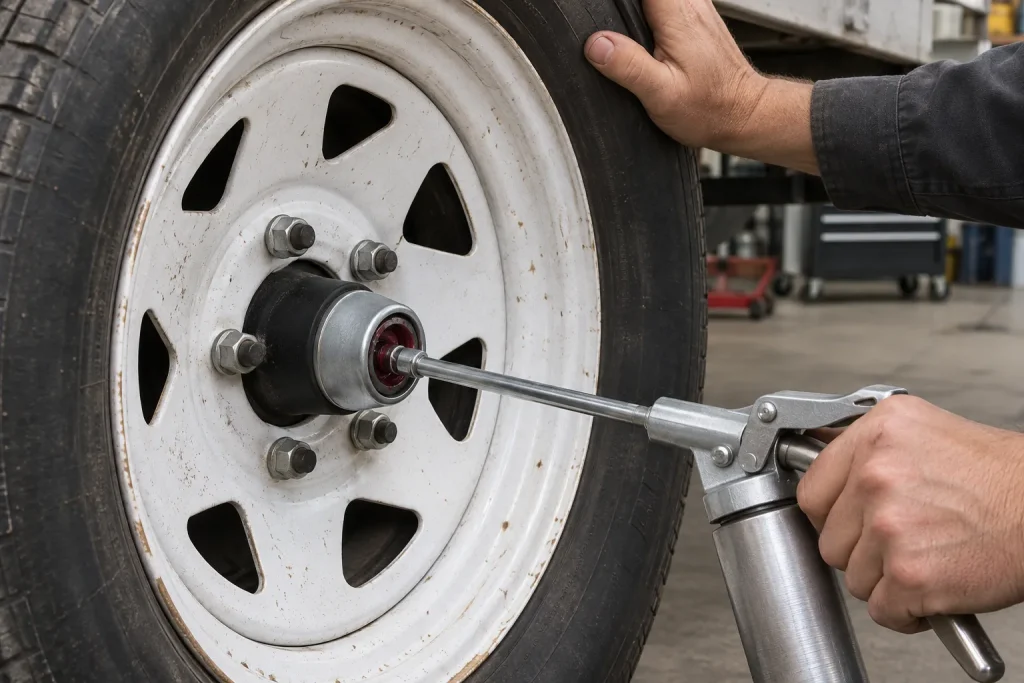
First, confirm that the fitting belongs to the system covered by your manual. Do not infer the internal design from a rubber plug alone.
Dexter and Lippert describe a general sequence of accessing the fitting, applying the specified grease while rotating the hub, watching for displaced grease, then cleaning the area and replacing the plug. Use the exact manufacturer’s procedure for your axle.
Dexter calls for a manual grease gun and warns against pneumatic guns that can deliver grease too quickly. Do not force grease into a system that is not behaving as the instructions describe. Stop and investigate rather than assuming more pressure will solve it.
Safe support comes before any work requiring a raised wheel. Use the trailer manufacturer’s approved frame lifting and support points and stands rated for the load. Do not support the trailer by the axle or suspension. Never work underneath it on a jack alone.
Prepare the correct manual, compatible grease, a suitable manual gun, clean wiping materials and the required lifting equipment before starting. If any of those are missing, arranging shop service is a reasonable choice.
Afterward, document what was done. Lubrication through a fitting should not be recorded as a complete disassembly and bearing inspection.
How to repack trailer bearings by hand
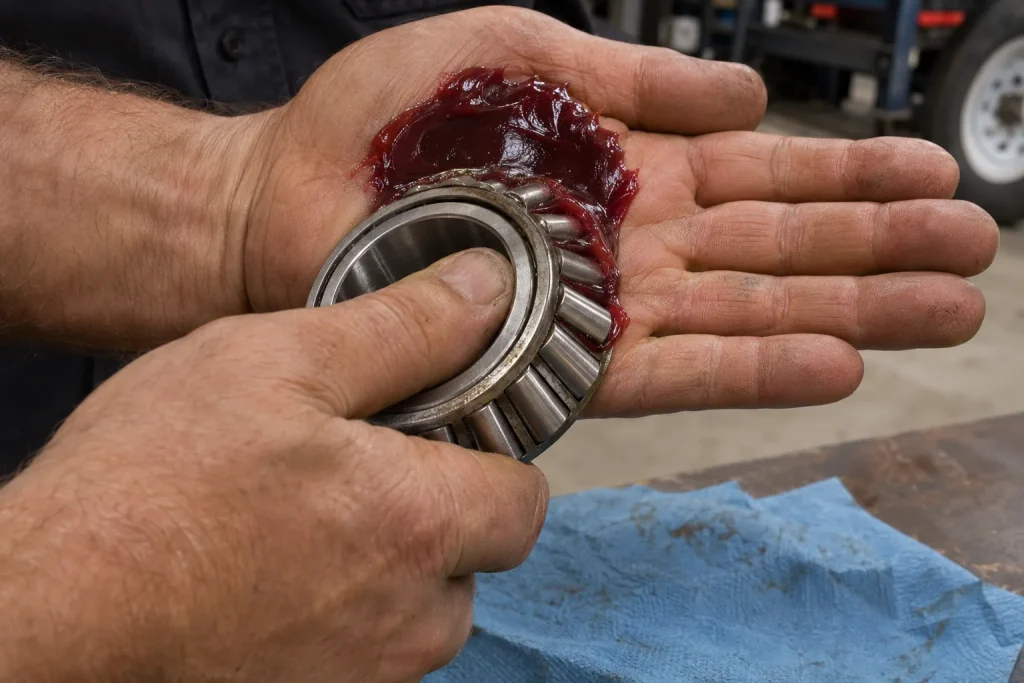
A complete repack follows a sequence, but the details depend on the assembly. This overview is intended to help you understand the work you are requesting, not to supply universal workshop instructions.
1. Identify and prepare
Confirm the axle and hub information, correct service instructions and replacement parts. Arrange safe support and a clean work area. Keep the parts from different wheel ends clearly separated.
Before authorizing a shop visit, ask what the quoted service includes. Does it include inspection, seals, adjustment and a check of adjacent brake components? Ask how additional damaged parts will be handled.
2. Remove and clean
The technician removes the wheel and hub as directed, then cleans the components for inspection. Do not improvise a cleaning method or spin a dry bearing with compressed air.
Old grease needs to be removed sufficiently for the inspection and any required change of lubricant. A new coating over a dirty assembly does not establish that its surfaces are sound.
3. Inspect the bearings, cups and related parts
The bearing cone is the assembly containing the rollers. The cup, often called the race, is the matching running surface in the hub.
Dexter and Lippert identify pitting, flaking or corrosion as reasons to replace affected bearing components. Their instructions call for replacing the cone and cup as a matched set when damaged. The seal, spindle and hub also need attention under the applicable procedure.
Inspection is the decision point. Do not continue with a routine repack when a component needs replacement or the cause of damage is uncertain.
4. Pack and reassemble
Dexter’s hand-packing guide describes working approved grease through the rollers and applying a light coating to the cup. Reassembly then requires the specified seal installation, bearing adjustment and retention method.
These steps are not interchangeable between hub systems. This page intentionally does not provide a generic spindle-nut torque or a universal “tighten, then back off” instruction.
5. Finish the checks
The technician completes the manufacturer’s rotation, adjustment and assembly checks. Wheels must be installed using the applicable fastener specifications and recheck schedule.
Ask for a record of the work, any parts replaced and anything that needs follow-up. Keep it with the trailer rather than in a collection of receipts you cannot identify later.
What grease should you use for trailer bearings?
Choose by the axle manufacturer’s specifications, not by color, brand popularity or a broad “heavy duty” label.
Dexter’s cited hub and bearing instruction sheet specifies a lithium-complex, NLGI No. 2 grease with additional performance requirements. NLGI grade alone is not the whole specification. Compare the product’s technical information with the full requirements for your axle.
Lippert warns against mixing incompatible grease types. If you cannot establish what is already in the hub, get guidance on cleaning and changing lubricant rather than adding a different product on top.
Keep the package or record the exact product in your maintenance log. A note that says “red grease” will not help the next person verify compatibility.
The question is not which grease wins an online ranking. It is whether the lubricant is approved for your equipment and whether the assembly is in a condition that can be serviced normally.
How to identify the replacement bearings you need
Start with the axle identification and the manufacturer’s parts information. Where the service process allows it, the markings on the old cone and cup can help confirm the match.
Record inner and outer bearing information separately. Do not assume they share a number. The cup, seal and retaining components also need to match the assembly.
For a parts or service inquiry, gather:
- Trailer make, model and identifying information.
- Axle label details.
- Hub type, if known.
- Readable photographs of labels and existing part markings.
- Any previous parts invoice.
- A description of the problem or planned service.
Do not order solely by the trailer’s body style. A stock trailer, enclosed trailer or flatbed label does not identify the bearing set. Nor should a kit be chosen only because its product photo resembles your old parts.
If the markings are unreadable or the axle has been changed, have the identification resolved before installation. A part that seems to fit is not a substitute for a verified match.
When to bring your trailer to Carl’s
Ask for professional help if a hub is seized, you find metal or damaged surfaces, the spindle appears damaged, the grease is leaking near the brakes or you cannot confirm the correct procedure. Also choose shop service if you lack the lifting equipment, tools or experience.
Carl’s lists bearing packing among its trailer service and repair services in Belle Fourche. Describe your trailer, its hub system and any symptoms when requesting an appointment or quote.
Ask whether the trailer should be moved at all if you suspect a wheel-end failure. Do not tow it to the shop simply because that is where the repair will happen.
Brake controller settings are a separate topic. If that is what you need to understand, see our trailer brake controller guide.
Trailer wheel bearings FAQ
Does a grease fitting mean I never need to repack or inspect?
No. Identify the system and follow its inspection and lubrication schedule. A fitting makes a particular lubrication method possible. It does not certify the condition of the bearings or seals.
Do Bearing Buddy-style caps replace bearing inspections?
Do not assume an accessory changes the axle manufacturer’s inspection requirements. Identify the exact product and follow both sets of applicable instructions. A cap is not proof that the assembly uses a spindle-lubrication system.
Can you overgrease trailer bearings?
Incorrect lubrication can create seal and brake-contamination concerns. Use the system’s procedure and approved equipment. Do not keep pumping simply because you have not used up the cartridge.
How much grease goes into each hub?
There is no universal quantity for every trailer hub. Use the procedure for the assembly you have, including its specified completion point. Do not borrow a fixed pump count from another trailer.
Should I replace both bearings if one is damaged?
Have the complete wheel end inspected. Replace the damaged cone and matching cup as directed, then follow the manufacturer’s findings and requirements for other parts. Do not assume an entire axle needs replacement or that its other bearings are automatically good.
Can I repack the bearings myself?
Only undertake the job if you can identify the system and perform the full procedure safely with the correct equipment. If you are uncertain about support, parts, seals or adjustment, use a qualified service provider.
What does bearing repacking cost?
Ask for a quote for your trailer and clarify what it includes. Inspection may reveal replacement parts or related work. This guide does not give a flat price or promise a completion time.
How long can I tow with a noisy bearing?
There is no safe mileage estimate to rely on. Stop safely and have the concern assessed before continuing. Adding grease is not proof that a damaged bearing is safe.
Plan your next service or trailer purchase
If you are keeping your trailer, start with its records and the work it needs. If you are comparing used trailers, ask about maintenance history and inspection rather than judging condition by appearance alone.
Shopping for a different hauling job? Explore stock trailers, flatbed trailers or enclosed trailers, then ask Carl’s about the actual equipment and service needs of the unit you are considering.