Carl's Trailer Sales

Your Trailer Headquarters in Belle Fourche, SD!

  • Directions
  • Contact Us
  • Show the search form

Trailers

  • All Trailers
  • Dump Trailers
  • Enclosed Trailers
  • Flatbed Trailers
  • Horse Trailers
  • Stock Trailers
  • Used Trailers

Products & Services

  • SureStep
  • Carl’s Customs
  • Truck Flatbeds
  • Bale Handlers
  • Feed Dispensers
  • Services

Contact

  • Home
  • Directions
  • Contact Us
  • Email Sign-ups

About

  • About Us
  • Manufacturer Links
  • Our Team
Hide the search form
  • All Trailers
  • Used Trailers
  • SureStep
  • Carl’s Customs
  • Truck Flatbeds
  • Bale Handlers
  • Feed Dispensers
  • Services

Enclosed Trailer Sizes Guide

November 3, 2026

Carl’s Trailer Sales

Enclosed trailer sizes explained: widths, lengths, height, GVWR, and how to match a box to your truck and cargo.
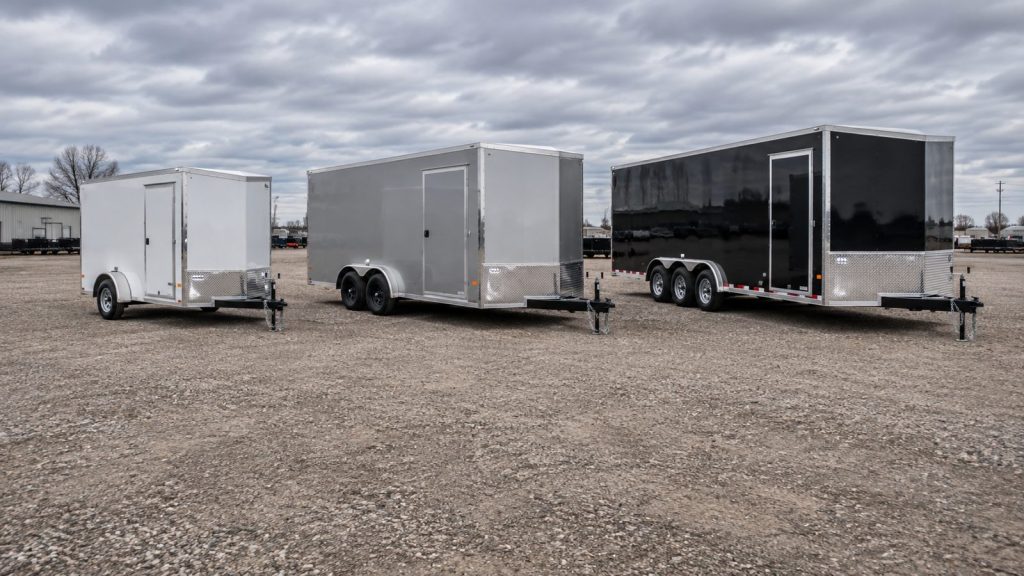
Three enclosed cargo trailers in different lengths, single axle and tandem axle
For illustration purposes only.
Enclosed Trailers
View Inventory

Picking an enclosed trailer size starts with what you haul, then what your truck can tow, then where you park. Nominal sizes such as 6×12 or 8.5×20 are marketing sizes. Measure interior length, width, height, and the rear door opening before you buy.

Empty weights vary by builder, axle rating, V-nose, ramp door, insulation, and cabinets. The tables below give common starting sizes, not exact weights. For the trailer you want, read the ratings on the certification label and ask for the builder sheet or a scale weight. See our enclosed trailers page and current inventory for what is on the lot today.

Quick picks  |  Dimensions  |  Common sizes  |  Weight and GVWR  |  How to choose  |  Axles  |  FAQ

Quick answer: what size do you need?

Use Common starting sizes Watch for
Tools / weekend cargo 5×8, 6×10, 6×12 Interior height and side door
Contractor / landscaping 6×12, 7×14, 7×16 Payload, ramp, E-track
Motorcycles / ATVs 6×12, 7×14, 7×16 Tie-downs, ramp angle, width
Car hauler 8.5×20, 8.5×24 and up Vehicle length + ramp + height
Moving / large cargo 7×16, 8.5×20, 8.5×24 Truck tow rating and tongue weight

Use these as starting points. Measure your largest item and leave room to walk and strap cargo.

Common enclosed trailer dimensions

Common widths are 5 foot, 6 foot, 7 foot, and 8.5 foot widebody. Lengths often run from 8 feet into the 28 and 32 foot range. Interior height options commonly land around 6 foot 6 inch, 7 foot, and 7 foot 6 inch and taller, depending on the builder.

Nominal size is not the same as usable space. A V-nose adds exterior length versus floor length. Wheel wells pinch width. Ramp doors and barn doors change how you load. Always measure the door opening and the clear floor.
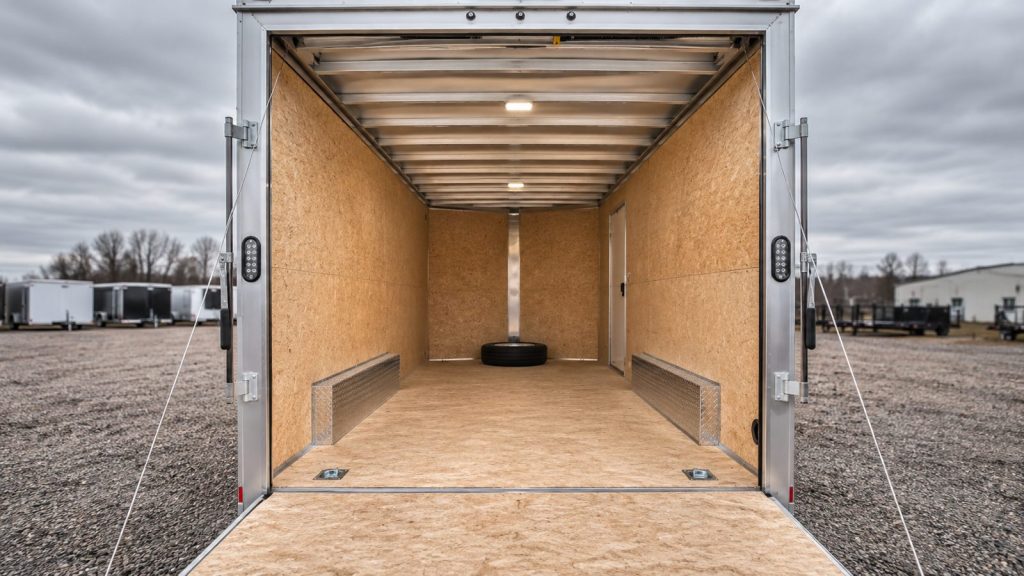
Empty enclosed trailer interior with wheel wells and plywood floor
For illustration purposes only.

Common sizes and typical uses

5×8 and 6×10 suit light cargo and camping gear. Measure first if you want to haul dirt bikes, since fit depends on the bikes, the door opening, and tie-down space. 6×12 is a frequent mid-size pick for tools and weekend loads. 7×14 and 7×16 give contractors and UTV owners more floor, and many come with tandem axles. 8.5×16 through 8.5×24 and longer move into car hauler and large cargo territory. A wider body gives you room for a car, cabinets, or two machines side by side.
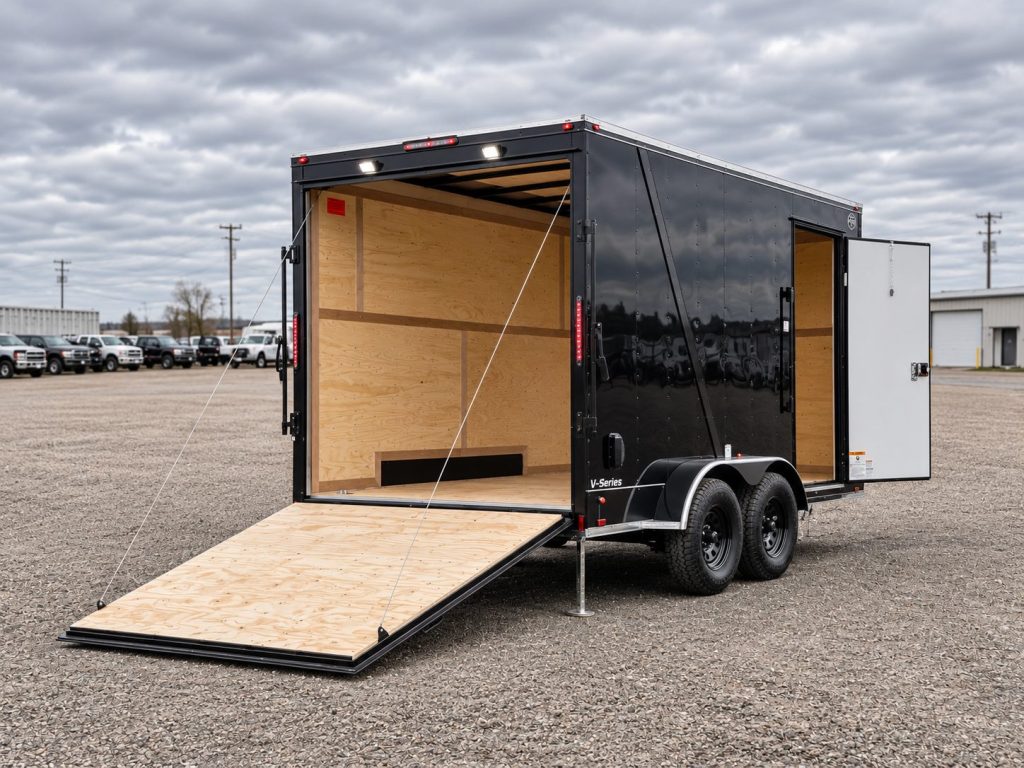
Black tandem-axle enclosed cargo trailer with the rear ramp door down
For illustration purposes only.
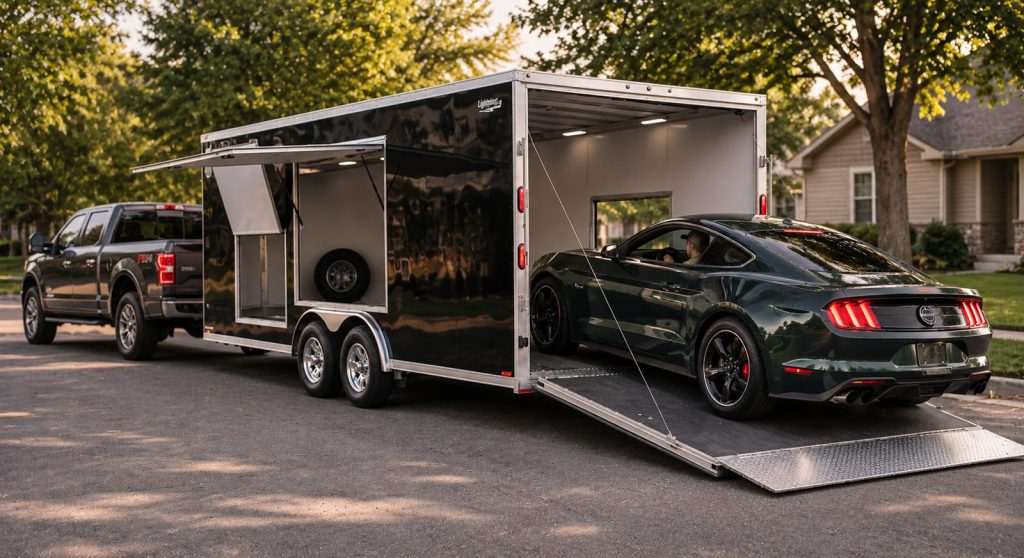
Car being loaded into an enclosed car hauler trailer
For illustration purposes only.

Empty weight, GVWR, payload, and tongue weight

GVWR is the maximum loaded weight of the trailer. Empty weight is the trailer as built. Payload is roughly GVWR minus empty weight. Tongue weight is the downward force on the hitch. A common rule of thumb for conventional trailers is about 10 to 15 percent of the loaded trailer weight on the tongue. Confirm hitch class, receiver rating, and truck payload. Tongue weight counts against truck payload.

Your trailer’s empty weight depends on its build and options, so two 6×12 trailers can weigh different amounts. The certification label lists ratings such as GVWR, not always the empty weight. Ask for the builder sheet, or weigh the empty trailer on a scale. Our trailer GVWR vs payload guide walks through the math.
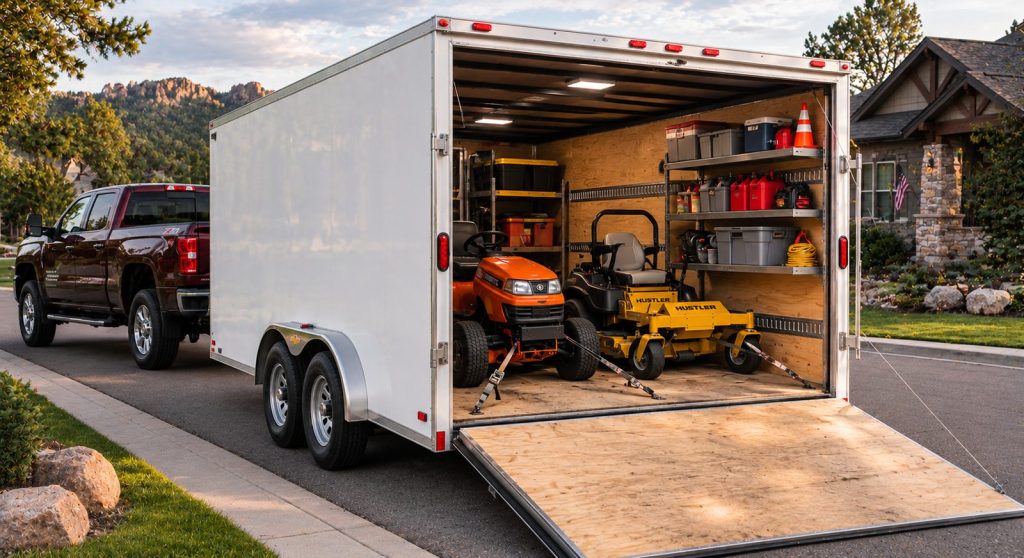
Enclosed trailer loaded with lawn mowers and landscaping tools
For illustration purposes only.

How to choose the right size

List what you haul and measure the largest and heaviest items. Add room for tie-downs, shelves, and walking space. If the cargo barely fits, you will not have room to strap it down. Check your tow vehicle’s towing capacity, hitch rating, and brake controller needs. Measure storage and driveway limits. Plan for the next machine you might buy, without jumping so large that the truck is overloaded.

Never exceed the truck’s tow rating, hitch class, or payload. If you are choosing a hitch style next, read bumper pull vs gooseneck. For gooseneck install help, see gooseneck hitch installation.

Single axle vs tandem axle

Single-axle enclosed trailers stay simpler and often lighter for small cargo. Tandem axles support higher GVWR and heavier loads. Axle ratings commonly appear in 3,500 pound, 5,200 pound, and 7,000 pound classes depending on the build. Confirm the plate. As weight goes up, brakes and a working breakaway system matter more. Check South Dakota requirements for lighting, brakes, and plates for your setup before you tow.

Compare flatbed and dump options if an enclosed box is not the right tool. Our trailer service and repair shop can help after you buy.

Enclosed trailer sizes FAQ

What is the most popular enclosed trailer size?

6×12 and 7×14 are common sizes for tools and mid-size cargo. Your cargo measurements matter more than what is popular, so measure your load before you choose.

How much does a 6×12 enclosed trailer weigh empty?

It depends on the manufacturer, axle rating, ramp, and options, so there is no single number. The certification label lists ratings such as GVWR. Ask for the builder sheet, or weigh the trailer you are considering.

What size enclosed trailer do I need for a car?

Measure the vehicle length, width, and height, then add ramp clearance and tie-down space. Many car haulers land in the 8.5-foot width and 20-foot-plus length range. Confirm interior height for spoilers, racks, and lifted suspensions.

Do I need a tandem-axle enclosed trailer?

Choose tandem when your loaded weight is more than a properly rated single-axle trailer can carry. Check the ratings on the specific trailer and load it the way the manufacturer recommends. Match axle rating and brakes to the loaded weight.

Can my half-ton tow an enclosed trailer?

Sometimes. It depends on the truck’s tow rating, hitch, payload, and the loaded trailer weight including tongue weight. Check the payload on the truck’s door-jamb label and the tow rating for your exact truck, then compare them to the loaded trailer weight. Do not rely on brochure peaks alone.

See enclosed trailers in Belle Fourche

Wareing Carl’s Trailer Sales is at 10958 US HWY 212, Belle Fourche, SD 57717. Call 605-892-4032 or toll-free 800-861-4032. Bring cargo measurements and your truck’s tow and payload numbers. We will walk the lot with you.

View Trailer Inventory
Contact Us

Trailer GVWR vs Payload

September 14, 2026

Trailer weight guide

Trailer GVWR vs payload, without the guesswork

GVWR is the loaded limit assigned to the trailer. Payload is the cargo capacity left after the trailer’s own weight is counted. The math looks simple. Getting the right numbers for your trailer takes a little more care.

View Trailer Inventory
Ask Carl’s a Question

GVWR and payload answer two different questions

A trailer can have a 10,000-pound GVWR and still carry far less than 10,000 pounds of cargo. The trailer itself uses part of that rating before you load a mower, tractor, pallet, livestock, hay, tools, or building material.

Federal regulations define gross vehicle weight rating, or GVWR, as the loaded weight of a single vehicle specified by its manufacturer. Your trailer is one vehicle. Your pickup is another. Each has its own ratings, and neither rating replaces the other.

Payload tells you how much weight is available for cargo after the trailer’s actual empty weight is removed from its GVWR. That actual empty weight matters. Two trailers from the same model family can weigh differently when one has ramps, a spare tire, a toolbox, a tarp system, a battery, or other installed options.

The trailer payload formula

Maximum payload capacity = Certified trailer GVWR – Actual empty, as-equipped trailer weight

Use pounds for both numbers. Do not mix a certified rating from one trailer with a brochure weight from another configuration.

Hypothetical example

10,000 lb GVWR – 3,000 lb actual empty weight = 7,000 lb maximum payload.

Those numbers are made up to show the calculation. They do not describe a trailer in Carl’s inventory. We will not assign a payload number to a real trailer without its certification label and verified empty weight.

The result is a maximum cargo figure for that verified setup. Every accessory installed later takes away from the room left for cargo. Cargo already stored in the trailer counts too.

Start with the label on the individual trailer

Look on the forward half of the trailer’s left side. Federal certification rules place the trailer label in that area so you can read it from outside. The label gives you the manufacturer’s GVWR and the gross axle weight rating, or GAWR, for each axle system.

Write down the VIN, GVWR, and each GAWR. Check that the label belongs to the trailer in front of you. A product page, marketplace listing, or old brochure can help you shop, but it cannot certify the weight of a different configuration.

Some applicable trailers carry a tire and loading placard near the certification label. The format depends on the trailer and its weight class. Use the information attached to your unit and the manufacturer’s manual.

What to record from the trailer

  • VIN and manufacturer
  • Certified GVWR
  • GAWR for every axle system
  • Tire size, load information, and cold inflation information shown on the placard
  • Installed options and accessories
  • Actual empty weight when the listed weight is not verified for that unit

Actual empty weight is the number shoppers miss

Base weights are useful when you compare trailer families. They are not a safe shortcut for the individual trailer. A longer deck, heavier floor, extra gate, spare tire, hydraulic equipment, battery, toolbox, chain tray, tarp, or dealer-installed part can change the empty weight.

Big Tex tells owners to weigh the trailer at a public scale when the empty weight is unknown. Diamond C gives the same practical advice and tells owners to include accessories. That is the clean way to move from an estimated payload to a trailer-specific calculation.

Dense loads deserve extra care. Gravel, soil, concrete, shingles, feed, and equipment can use the available payload before the deck or box looks full. Volume does not tell you weight. A scale does.

A scale check needs the complete trailer weight

Part of a hitched trailer’s weight rests on the tow vehicle through the tongue, gooseneck, or fifth-wheel connection. The federal definition still treats the trailer as one vehicle. Reading only the trailer axles on a scale can leave out the part supported at the hitch.

Ask the scale operator for the right procedure before you pull onto the platform. One practical method uses a weight for the complete hitched combination and a comparable weight for the loaded tow vehicle without the trailer. Subtracting the tow-vehicle-only total from the combined total captures the complete trailer weight, including the hitch-supported portion.

  1. Load the tow vehicle with the same people, fuel, tools, and bed cargo for both readings.
  2. Weigh the complete hitched combination and record each available axle-group reading.
  3. Park safely, disconnect the trailer where the facility permits it, then weigh the tow vehicle in the same loaded condition.
  4. Subtract the tow-vehicle-only total from the combined total to find complete trailer weight.
  5. Compare that result with the trailer GVWR and compare measured axle loads with their GAWR values.

Scale layouts and operating rules differ. Follow the facility’s directions. If the two readings are not comparable, the subtraction will not give you a clean trailer number.

GVWR is not the sum of the axle stickers

Do not add two axle ratings and call that number the trailer’s GVWR. The manufacturer assigns the trailer GVWR to the complete vehicle. Frame, suspension, wheels, tires, coupler, brakes, and the certified configuration can all affect the final rating.

GAWR still matters. You can be under the trailer’s GVWR and put too much weight on one axle system through poor load placement. Check the total and the axle readings. Both need to stay inside their own ratings.

A stronger tow vehicle does not raise the trailer’s GVWR either. Heavier axles, springs, tires, or airbags do not give an owner permission to rewrite the certification label. Questions about a modified trailer belong with the original manufacturer or another qualified manufacturer that can evaluate and certify the work.

The pickup and hitch have separate limits

A trailer can fit its own GVWR and still be too much for the truck or hitch. Check the tow vehicle’s owner manual, certification label, payload label, GVWR, GAWR, GCWR, and tow rating for the truck’s exact configuration. People, tools, bed cargo, and hitch-supported trailer weight use capacity on the tow vehicle.

Check the receiver or in-bed hitch, ball, coupler, safety equipment, tires, wheels, and brakes. The lowest applicable rating can stop the plan before the trailer reaches its own payload limit.

Our bumper pull vs gooseneck guide explains how hitch location changes the truck setup. The trailer tire guide shows how to read the date code on the sidewall. Carl’s handles trailer service and repair in Belle Fourche when your unit needs inspection or work.

Bring the load plan when you shop

Write down the heaviest machine, attachment, livestock load, or material you expect to carry. Count tools, tie-down gear, spare parts, and anything that stays on the trailer. Bring your tow-vehicle information too.

Carl’s Trailer Sales can help you compare the labels and features on current trailer inventory. You can browse flatbed trailers, dump trailers, stock trailers, and used trailers. The final payload check still belongs to the individual trailer and its verified weight.

Shop Trailers in Belle Fourche

Trailer GVWR vs payload FAQ

What is the difference between trailer GVWR and payload?

Trailer GVWR is the manufacturer-assigned maximum loaded weight of the trailer. Payload is the amount of cargo the trailer can carry after subtracting the trailer’s actual empty, as-equipped weight from its GVWR.

How do I calculate my trailer’s payload capacity?

Subtract the trailer’s actual empty, as-equipped weight from the GVWR shown on its certification or VIN label. Installed accessories and equipment must be included in the empty weight. If that weight is not verified, weigh the trailer before relying on the result.

Where can I find my trailer’s GVWR?

Federal rules require the trailer certification label to show GVWR and GAWR. For trailers, that label is placed on the forward half of the left side. Use the label for your specific trailer rather than a general model listing.

Do spare tires, toolboxes, ramps, and other accessories reduce payload?

Yes. Anything added to the trailer increases its empty or loaded weight and reduces the weight available for cargo. Use the trailer’s actual as-equipped weight when calculating payload.

Can higher-rated axles or a stronger tow vehicle increase trailer payload?

No. Axle ratings and tow-vehicle ratings do not replace the GVWR assigned to the trailer. The trailer, axles, tires, hitch system, and tow vehicle must each remain within their own manufacturer ratings.

Be the first to know

Receive an email each day that there are new trailer listings.

Subscribe now

Physical Address

Wareing Carl's Trailer Sales
10958 US HWY 212
Belle Fourche, SD 57717

Map and Directions

Hours

Monday - Friday:
8:00 am - 5:00 pm
Saturday: 8:00 am - 12:00 pm

Phone

(605) 892-4032
(800) 861-4032

Mailing Address

Wareing Carl's Trailer Sales
PO Box 98
Belle Fourche, SD 57717

Contact Us

Carl's Trailer Sales logo

© 2026 Wareing Carl's Trailer Sales, A Wareing Motors Company · Log in · Website by Black Hills Web Works